




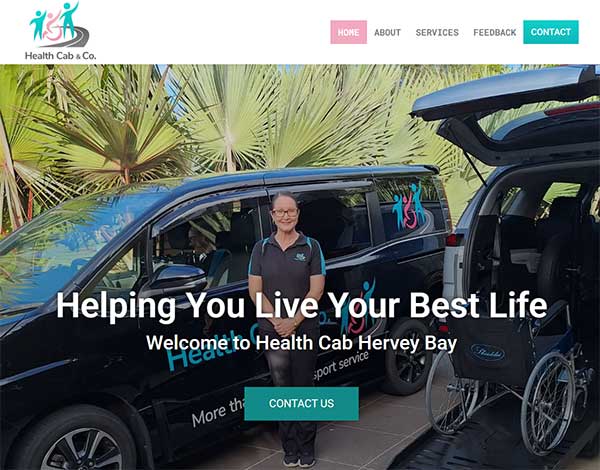
Thank You to Rennai and the team for working with us for your website refresher. If you are looking for NDIS transport services in Hervey Bay, make sure to check out Health Cab & Co.
View the Live Website Here
The National Disability Insurance Scheme (NDIS) has transformed the way disability services are delivered across Australia. As the sector continues to grow, NDIS registered providers face increasing competition and greater expectations from participants, families, support coordinators, and carers. A professional website is no longer simply a digital brochure. It is a critical business tool that helps providers communicate their services, build trust, generate enquiries, and support participant engagement.
For NDIS registered providers, effective web design requires a clear understanding of accessibility, compliance, user experience, and the unique needs of the disability sector. A well-designed website can help an organisation stand out while making information easier to access for the people who need it most.
Why a Professional Website Matters for NDIS Providers
Many people searching for disability support services begin their research online. Participants, family members, and support coordinators often compare multiple providers before making contact. A professional website creates a strong first impression and demonstrates that a provider is organised, trustworthy, and committed to delivering quality services.
An outdated or difficult-to-use website can create barriers for potential participants. Visitors may leave the site if they cannot quickly find information about services, locations, eligibility, or contact details. In contrast, a modern and well-structured website helps users understand what the provider offers and encourages them to take the next step.
For registered providers, a website also serves as a platform to communicate organisational values, showcase expertise, and explain how services support participants in achieving their goals.
Accessibility Should Be a Priority
Accessibility is one of the most important considerations when designing a website for an NDIS registered provider. Since many visitors may have disabilities that affect how they access online information, websites should be designed to accommodate a wide range of needs.
Accessibility features may include clear navigation, readable fonts, strong colour contrast, keyboard-friendly functionality, alternative text for images, and compatibility with screen readers. Content should also be written in plain language wherever possible to make information easier to understand.
An accessible website improves the experience for all users, not just people with disabilities. It demonstrates a provider’s commitment to inclusion and supports equal access to information.
Clear Navigation and User Experience
Visitors should be able to find important information quickly and easily. Confusing menus, cluttered layouts, and excessive text can create frustration and reduce engagement.
A successful NDIS provider website typically includes clearly organised sections covering services, about the organisation, locations, careers, testimonials, contact information, and referral pathways. Navigation menus should be logical and consistent throughout the website.
The user journey should be carefully considered. Whether a visitor is looking for support services, seeking employment opportunities, or making a referral, the website should guide them efficiently toward their goal.
Simple navigation can significantly improve conversion rates and help turn website visitors into enquiries.
Mobile-Friendly Design Is Essential
A large proportion of website traffic now comes from smartphones and tablets. As a result, responsive web design is essential for NDIS providers.
A mobile-friendly website automatically adjusts to different screen sizes, ensuring that content remains easy to read and navigate regardless of the device being used. Buttons should be easy to tap, forms should function correctly on mobile devices, and pages should load quickly.
Providers who neglect mobile optimisation risk losing potential participants and referrals due to a poor user experience.
Building Trust Through Website Content
Trust plays a major role in the decision-making process for participants and their families. Website content should help reassure visitors that the provider is capable, professional, and experienced.
Important trust-building elements may include information about NDIS registration, staff qualifications, organisational values, service areas, participant-focused approaches, and years of experience. Professional photography can also help create a more authentic and welcoming impression.
Clear and accurate content helps visitors understand exactly what services are available and whether the provider is a suitable fit for their needs.
Service Pages That Provide Useful Information
Many NDIS providers offer a range of supports across different categories. Rather than listing all services on a single page, it is often beneficial to create dedicated service pages.
Individual service pages allow providers to explain specific supports in greater detail. These pages can describe how services are delivered, who may benefit, and what participants can expect throughout the support process.
Detailed service pages also help visitors locate relevant information more quickly, improving overall website usability.
Search Engine Visibility
A professionally designed website should also be structured to support search engine visibility. When people search online for disability support services, providers want their websites to be discoverable.
Search engine optimisation involves creating relevant content, using clear page structures, maintaining fast website performance, and ensuring technical best practices are followed. Local visibility is particularly important for providers operating within specific regions or service areas.
While search rankings are influenced by many factors, a well-designed website provides a strong foundation for online visibility.
Contact Forms and Enquiry Management
An NDIS provider website should make it easy for visitors to get in touch. Contact forms, phone numbers, email addresses, and service area information should be clearly displayed throughout the website.
Enquiry forms should be straightforward and only request necessary information. Complex forms can discourage potential participants from making contact.
Fast and efficient enquiry management helps providers respond promptly and improve participant engagement from the first interaction.
Ongoing Website Maintenance
Launching a website is only the beginning. Ongoing maintenance is important to ensure information remains accurate, security updates are applied, and performance standards are maintained.
Providers should regularly review content, update service information, and ensure contact details remain current. Routine maintenance also helps identify technical issues before they affect visitors.
A website that is actively maintained reflects a professional organisation that values quality and reliability.
Conclusion
Web design plays a crucial role in the success of NDIS registered providers. A professional website helps build trust, improve accessibility, support participant engagement, and communicate services effectively. By focusing on accessibility, user experience, mobile responsiveness, informative content, and ongoing maintenance, providers can create an online presence that supports both organisational growth and positive participant outcomes. In an increasingly competitive sector, a well-designed website is an essential asset that helps NDIS providers connect with the people they are there to support.