




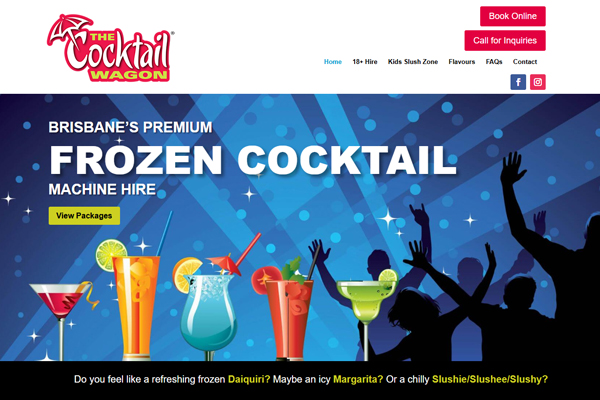
Thank You to Lachlan and the team at the Cocktail Wagon! We love working with you guys and look forward to taking care of your website into the future. Should you want Frozen Slushy Machine Hire for your Brisbane event, please consider the Cocktail Wagon.
https://thecocktailwagon.com.au/
A professional website is an essential business tool for commercial food equipment suppliers looking to present their products, attract new customers and support business growth. Companies supplying commercial food equipment, frozen slush machines, beverage dispensers, syrups and related hospitality products need a website that communicates their expertise while making it easy for customers to explore their range.
Unlike a general retail website, a commercial food equipment supplier’s website like the one created for the cocktail wagon often needs to serve several types of customers, including cafés, restaurants, convenience stores, takeaway businesses, catering companies, event operators and other hospitality professionals. These customers may be researching equipment for the first time, comparing product specifications, sourcing replacement supplies or looking for a dependable supplier for ongoing purchases.
Effective website design combines a clear layout, professional presentation, useful product information and practical functionality. Every element should help visitors understand what the business offers, identify suitable products and take the next step, whether that involves requesting a quotation, making an enquiry or placing an order.
Creating a Clear and Professional Website Layout
The layout establishes how visitors navigate a website and interact with its content. For commercial food equipment suppliers, the structure should be straightforward, organised and consistent across every page.
The homepage should immediately communicate the company’s core offering. Visitors should be able to recognise whether the business specialises in commercial kitchen equipment, beverage dispensing systems, frozen drink machines, food preparation equipment or a combination of these categories.
The Cocktail Wagon has a prominent headline, supporting description and high-quality product photography can introduce the business effectively. The homepage should also provide clear navigation to important sections, including products, equipment categories, consumable supplies, company information and contact details.
A well-organised menu reduces the effort required to find products. For example, a supplier selling frozen slush machines and syrups could separate its range into commercial slush machines, syrup flavours, replacement parts, accessories and consumables. Customers looking for a particular item can then navigate directly to the relevant category.
The layout should also maintain consistency in typography, spacing, colours, buttons and image presentation. Consistent design creates a more professional appearance and helps visitors understand how to use the website.
The Cocktail Wagon: Presenting Commercial Food Equipment Professionally
Product presentation is particularly important when selling commercial equipment. Customers often need to understand how a machine looks, what it does, how much capacity it offers and whether it suits their business requirements.
High-quality photographs should show equipment clearly, ideally from multiple angles where appropriate. Images of frozen beverage machines, commercial mixers, refrigeration units and other equipment should accurately represent the products being sold.
Product descriptions should provide practical information rather than relying on vague promotional language. Depending on the product, relevant details may include dimensions, capacity, power requirements, operating instructions, materials, cleaning requirements, warranty information and compatibility with accessories or consumables.
For example, a frozen slush machine product page could explain its intended commercial use, available bowl capacity, operating requirements and suitable syrup products, provided those details have been verified for the particular model.
Clear product photography and accurate descriptions help customers make informed purchasing decisions. They can also reduce unnecessary enquiries caused by missing or confusing information.
Presentation should extend beyond individual products. Consistent product images, readable descriptions and clearly displayed specifications help the entire catalogue feel organised and trustworthy.
Organising Product Categories and the Catalogue
A commercial food equipment website may contain a broad range of products, making effective catalogue organisation essential. Customers should not need to browse through unrelated items to find the equipment or supplies they require.
Product categories should reflect the way customers typically shop. A business supplying frozen beverage equipment, for instance, could organise its catalogue into machines, syrups, cups, accessories, replacement parts and cleaning supplies, depending on the actual products available.
Each category page should include a clear heading, a brief explanation of the product range and an organised display of available items. Product cards can show a product image, name, short description and price where applicable.
For larger catalogues, filters can make browsing more efficient. Depending on the equipment range, customers might filter products by brand, machine capacity, product type, price or availability.
Although that was not needed for the Cocktail Wagon, in general search functionality is also valuable, especially for repeat customers who already know a model name, product code or syrup flavour. A useful search tool should return relevant results and communicate clearly when no matching products are available.
A carefully structured catalogue supports both new customers exploring the range and established customers returning to purchase familiar products.
Designing Effective Product Pages
Product pages are among the most important sections of a commercial equipment website because they help convert interest into enquiries or sales.
Each page should focus on one product and present its essential information in a logical order. The product name and main image should be easy to identify, followed by a concise description, important specifications and purchasing options.
For equipment sold to businesses, detailed specifications are often particularly useful. Buyers may need to check installation requirements, electrical compatibility, dimensions and operating capacity before deciding whether a machine is appropriate for their premises.
Additional photographs, instruction documents and downloadable specification sheets can provide further assistance when they are available and accurate.
For consumable products such as frozen slush syrups from the Cocktail Wagon, product pages can highlight flavour, container size, storage instructions, preparation guidance and compatibility with specific machines where verified.
Calls to action should be prominent and relevant. Depending on the sales process, suitable options include requesting a quote, contacting the sales team, adding an item to the cart or enquiring about bulk orders.
The goal is to give customers enough reliable information to make progress without overwhelming them with unnecessary content.
The Cocktail Wagon: Building a Strong Visual Identity
A professional visual identity helps commercial food equipment suppliers establish recognition and present a consistent business image. The website should reflect the company’s positioning, whether it serves budget-conscious operators, premium hospitality venues, large commercial customers or a broad market.
Colours, typography, imagery and graphic elements should work together rather than competing for attention. A restrained colour palette, readable fonts and consistent image treatments can create a clean, modern appearance.
Product photography should remain the main focus on catalogue pages. Decorative elements should support the information rather than distract from it.
For suppliers of frozen beverage machines and syrups, photographs of finished slush drinks can help communicate how the products may be used in a commercial setting. However, lifestyle imagery should complement, not replace, photographs of the actual equipment and product packaging.
Branding should also remain consistent across the homepage, product catalogue, enquiry forms, emails and other customer-facing materials. This consistency helps visitors recognise the company and reinforces a professional impression.
Mobile-Friendly and Responsive Website Design
Many customers access supplier websites using smartphones or tablets while working, travelling between locations or researching potential purchases. A commercial food equipment website should therefore function effectively across different screen sizes.
Responsive design allows page layouts to adapt to the device being used. Navigation menus should be easy to open, product images should remain clear and text should be readable without excessive zooming.
Buttons and form fields need sufficient space for touch interaction. Product specifications should be presented in a format that remains easy to read on smaller screens, while important information should not disappear behind awkward layouts.
Mobile visitors should be able to search for equipment, browse product categories, review specifications and contact the business without unnecessary difficulty.
Performance matters as well. Large product images can slow down page loading if they are not properly optimised. Appropriate image sizing, efficient code and suitable hosting can help improve responsiveness.
A consistent mobile experience ensures that customers can access essential information regardless of the device they use.
Essential Website Functionalities for Commercial Suppliers
A professional design needs practical functionality to support daily business operations. The most appropriate features depend on the company’s product range, sales model and customer requirements.
For suppliers accepting online orders, an ecommerce system can provide product listings, shopping carts, checkout, payment processing and order confirmation. Inventory management may help keep displayed stock information accurate when integrated with the business’s stock system.
For suppliers that primarily sell through quotations, an enquiry-based catalogue may be more appropriate. Customers can select equipment, provide details about their business and request pricing without completing a conventional online purchase.
Useful functionality may include:
- Product search and filtering: Helps customers find relevant equipment, accessories and consumables quickly.
- Quote request forms: Supports enquiries for large orders, customised requirements or commercial equipment packages.
- Contact forms: Allows prospective customers to request information or arrange a discussion with the sales team.
- Customer accounts: Can support order histories, saved details and repeat purchasing where these features are available.
- Technical documentation: Provides access to accurate manuals, specifications and installation information.
- Stock and delivery information: Helps customers understand availability and relevant delivery arrangements.
- Related product suggestions: Highlights compatible accessories, replacement parts and consumables where appropriate.
These features should be selected according to genuine business needs. Adding unnecessary functionality can increase complexity without improving the customer experience.
Simplifying Enquiries and Customer Communication
Clear communication is essential for commercial suppliers because equipment purchases can involve technical questions, delivery considerations and ongoing supply arrangements.
Contact details should be easy to locate, and the website should explain how customers can reach the business. Depending on the company’s operations, communication options may include telephone, email and an online enquiry form.
Enquiry forms should request only the information needed to respond effectively. A supplier may ask for a customer’s name, business name, contact details, products of interest and a brief description of their requirements.
For larger equipment enquiries, additional fields may help clarify quantities, intended use or delivery location. However, forms should not become unnecessarily complicated, as excessive questions can discourage submissions.
Clear confirmation messages should tell customers when their enquiry has been submitted successfully. The business should also establish an internal process for reviewing enquiries and responding within a reasonable timeframe.
A website that supports straightforward communication can make it easier for prospective customers to progress from initial research to a genuine sales conversation.
Search Engine Visibility and Website Content
Search engine optimisation can help commercial food equipment suppliers reach customers searching for relevant products and services. A well-structured website makes it easier for search engines to understand the subject of each page and this is what we achieved for the Cocktail Wagon.
Category names, page titles, headings and product descriptions should accurately describe the products available. A supplier specialising in frozen slush machines, for example, should use relevant terminology naturally throughout its equipment pages and supporting content.
Useful informational content can address common customer questions about equipment selection, cleaning, maintenance, syrup preparation and commercial beverage service. Articles should be accurate, practical and relevant to the products the business supplies.
Technical considerations also matter. Descriptive page addresses, appropriate image alternative text, mobile responsiveness, secure connections and reasonable loading speeds contribute to a well-maintained website.
Search optimisation should never come at the expense of clarity. Repeating keywords excessively or publishing misleading claims can damage the quality of the customer experience.
The primary objective is to provide useful information that matches the needs and search intentions of potential customers.
Building Trust Through Accurate Information
Commercial customers need confidence that a supplier understands its products and can communicate requirements accurately. A website can support this confidence through transparent information and professional presentation.
Company details, business contact information, delivery policies, returns conditions and warranty terms should be clearly presented where relevant. Any claims about product performance, certifications, warranties or manufacturer relationships should be verifiable.
Customer testimonials and case studies may also be useful when they are genuine and published with appropriate permission. Examples of equipment installations or customer applications can demonstrate how products are used in real commercial environments.
For equipment that requires installation, maintenance or specialist support, the website should explain which services the business actually provides. It should not imply that technical assistance or after-sales support is available unless the company can deliver it.
Accurate information helps establish realistic expectations and supports better purchasing decisions.
Conclusion
Professional website design for commercial food equipment suppliers requires more than an attractive homepage. It involves a clear layout, organised product categories, informative product pages, consistent visual presentation and reliable functionality.
A well-designed website should help customers understand the equipment available, compare relevant products, find compatible supplies and contact the business with confidence. Responsive design, efficient search, suitable enquiry tools and accurate technical information can further improve the experience.
For businesses selling frozen slush machines, syrups and other commercial food and beverage products, the website should reflect the practical needs of hospitality operators and other commercial buyers.
By combining thoughtful presentation with useful functionality and trustworthy information, a commercial food equipment supplier can create a professional online presence that supports customer relationships, streamlines enquiries and provides a strong foundation for long-term business growth.