




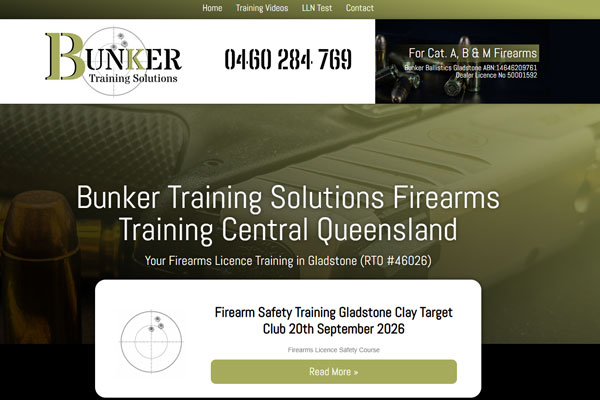
Thank you to the team at Bunker Training Solutions for choosing us to create your new website. Bunker Training Solutions provides Firearms Safety Training in Gladstone and Central Queensland
View the Bunker Training Solution Website Here
A new website for a firearms safety training provider is more than a digital business card.
For people seeking firearms safety education, licensing information, or structured training, the site can be an important first contact.
It should make the provider’s services easy to understand.
Additionally, it communicates a clear commitment to responsible firearms handling, legal compliance, and safe practices.
A well-designed new website can clarify the process of finding appropriate training.
Additionally, visitors should quickly understand what the provider offers and who the courses are for.
They should know any requirements that may apply and how to take the next step.
Because firearms training involves serious responsibilities, accurate information and clear communication are essential.
Why a Firearms Safety Training Provider Needs a New Website
A training provider may already have an established reputation in its local community, but a new website can make its services much easier to access. People increasingly use websites to research businesses before making contact, and training providers are no exception.
A modern website gives visitors a central place to learn about available courses and the provider’s approach to safety. Instead of relying on scattered information, prospective students can find the essential details in one location.
The website can also help establish expectations before a person attends training. Firearms safety education is not simply about learning how to operate a firearm. Responsible training can involve understanding safety principles, applicable laws and regulations, safe storage responsibilities, range procedures, risk awareness, and appropriate conduct.
Presenting this information clearly helps potential students understand that training is structured around responsibility rather than simply practical firearm use.
A Clear Introduction to the Training Provider
One of the first things visitors will expect from a new website is a straightforward introduction to the organization and its instructors.
A provider can use this section to explain its experience, training philosophy, qualifications, and commitment to safety. Where instructors hold relevant credentials or approvals, the website can describe those credentials accurately without making unsupported claims.
This information matters because prospective students want to know who will be responsible for their training. A professional introduction can provide useful context before someone decides to inquire or enroll.
The website should also make it clear which locations the provider serves and whether training is conducted at a particular facility, range, classroom, or other approved venue. Details should be kept current so that visitors are not relying on outdated information.
What Visitors Can Expect From the Courses
A new website should provide a practical overview of what students can expect from firearms safety training.
Depending on the provider, courses may cover subjects such as fundamental firearms safety rules, safe handling procedures, storage obligations, legal responsibilities, range safety, and procedures for responding to potentially unsafe situations. The precise curriculum will depend on the relevant jurisdiction, course accreditation, and training requirements.
The website should distinguish between general educational information and formal requirements. Regulations governing firearms ownership, licensing, training, storage, and use vary between jurisdictions and can change over time. A responsible provider should therefore present regulatory information carefully and encourage students to rely on current official requirements when making legal decisions.
For students, knowing what a course covers can make the training process feel more predictable. They can arrive with a basic understanding of the subjects that will be addressed and the responsibilities expected of them.
Emphasis on Safety and Responsibility
Safety should be one of the central themes of the new website.
Firearms are potentially dangerous items, and responsible training places considerable emphasis on preventing accidents and unsafe behavior. A website should reflect that reality in its language and presentation.
Rather than treating firearms training as a purely technical exercise, the website can explain that students are expected to develop a safety-focused mindset. This includes following instructions, understanding range procedures, treating firearms with appropriate caution, and recognizing that legal and personal responsibilities continue beyond the training environment.
The site can also explain that training is intended to help students understand established safety practices rather than encourage careless or inappropriate firearm use.
This emphasis is useful for both new and experienced participants. Someone who has never handled a firearm may want reassurance that the training environment is structured and supervised, while an experienced participant may want to understand the provider’s particular approach and requirements.
Information for New Students
For people attending firearms safety training for the first time, uncertainty about the process can be a significant concern. A new website can address this by providing a dedicated section for new students.
This section might explain how enrollment works, what documentation may be required, how students should prepare, what identification or equipment requirements apply, and what happens when they arrive.
The exact requirements should come from the provider and the applicable rules. The website should avoid presenting assumptions as universal requirements because procedures can differ between courses and jurisdictions.
It can also be helpful to explain basic expectations around punctuality, appropriate conduct, following instructor directions, and asking questions when something is unclear. These details reinforce the idea that safety depends on communication and responsible behavior.
Course and Booking Information
Visitors should not have to search through multiple pages to determine how to inquire about training.
A well-organized website can present course names, descriptions, dates where applicable, locations, prerequisites, costs, and enrollment information in an easy-to-understand format. If courses are offered at different levels or for different purposes, each should have its own clear description.
Any prerequisites should be stated plainly. If a particular course is intended for a specific licensing pathway or requires previous training, visitors should be able to identify that before registering.
Accurate scheduling information is equally important. Outdated course dates or unclear booking instructions can create unnecessary frustration and may cause people to contact the provider simply to clarify basic information.
Frequently Asked Questions
A comprehensive FAQ section can answer many of the questions that prospective students commonly have.
Questions might address who can attend a course, what identification is required, what the training involves, whether beginners are welcome, what happens if a student cannot attend a scheduled session, and what documentation may be issued after successful completion.
The FAQ should remain factual and avoid giving legal advice beyond the provider’s authority. Where a question concerns current legislation or licensing decisions, the website can explain the provider’s role while directing visitors to the appropriate government authority for authoritative legal information.
This distinction is especially important because firearms laws can be complex and jurisdiction-specific.
A Professional and Accessible Design
The visual design of the new website should support the seriousness of the subject without becoming unnecessarily complicated.
Clear navigation, readable text, straightforward menus, and well-organized course information can make the site easier to use. Important information should not be hidden behind excessive graphics or complicated navigation.
The website should also work well on mobile devices. Many visitors will first encounter the provider through a phone, so course descriptions, contact details, schedules, and frequently asked questions should remain easy to read on smaller screens.
Accessibility is another consideration. Clear headings, sufficient text contrast, descriptive labels, and logical page structures can help a wider range of visitors navigate the website.
Building Confidence Through Accurate Information
Trust is particularly important for a firearms safety training provider. The website should therefore prioritize accuracy over exaggerated marketing claims.
Information about qualifications, course approvals, training locations, costs, schedules, and legal requirements should be kept current. If something changes, the relevant webpage should be updated promptly.
The provider can also use the website to communicate its standards. Clear expectations demonstrate that safety is treated as an ongoing responsibility rather than simply a topic covered during a single lesson.
A professional website does not need to make unrealistic promises. Instead, it should give visitors enough reliable information to understand the training provider, the courses available, and the responsibilities associated with participation.
What to Expect From the New Website
Ultimately, visitors should expect the new website to make firearms safety training easier to understand and easier to navigate.
They should be able to learn who the provider is, what training is offered, what each course covers, what requirements apply, and how to make an inquiry. They should also gain a clear understanding that responsible firearms education involves safety, legal awareness, discipline, and respect for established procedures.
For a training provider, the new website represents an opportunity to communicate those principles from the very first interaction. For prospective students, it can provide a useful starting point for understanding the training process and preparing appropriately.
The most effective website will therefore be one that combines clear information with a consistent emphasis on safety and responsibility. By keeping course details accurate, explaining expectations clearly, and presenting information in an accessible way, a firearms safety training provider can create a digital presence that reflects the seriousness of the education it provides.