




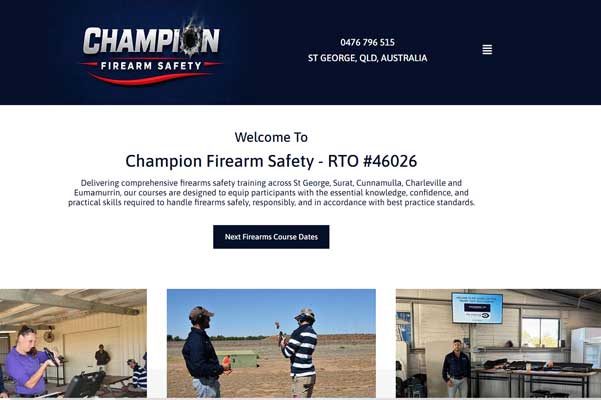
Thank You to Dean and Holly from Champion Firearm Safety for being able to create your new website. All the very best with your new business and I look forward to working with you going forward.
See the new website here
Are You providing courses or events and need a website to promote them? The new website for Champion Firearm Safety allows the self administration of events to effectively promote them. Training providers operate in an increasingly competitive and digitally driven environment. Whether delivering vocational education, compliance training, corporate development programs, or specialised skills courses, the website has become a central platform for attracting learners, communicating value, and facilitating enrolments. Professional web design tailored specifically to training providers ensures that these objectives are achieved effectively.
A well-designed website is not just a marketing asset. It functions as an information hub, a registration system, and often an extension of the training experience itself. Prospective students rely on it to understand course offerings, evaluate credibility, and make informed decisions. If the design is unclear, outdated, or difficult to navigate, it can quickly deter potential enrolments.
Understanding the Needs of Learners and Organisations
Training providers serve a diverse audience that may include individual learners, corporate clients, and government-funded participants. Each group has different expectations and priorities, and web design must accommodate these differences.
Individual learners typically look for clarity, affordability, and ease of enrolment. They want to understand course outcomes, duration, and any prerequisites without unnecessary complexity. Corporate clients, on the other hand, are often focused on scalability, compliance, and measurable outcomes. They require clear information about customisation, reporting, and delivery formats.
Effective web design ensures that these different user groups can quickly find relevant information. Structured navigation, clear segmentation of services, and tailored messaging help guide users to the content that matters most to them.
Clear Course Presentation and Structure
One of the most important elements of a training provider’s website is how courses are presented. Poorly structured course pages can create confusion and reduce conversion rates.
Each course should have a dedicated page that includes essential information such as course objectives, duration, delivery method, assessment requirements, and certification outcomes. This information should be presented in a logical and easy-to-scan format.
Consistency across course pages is equally important. When users browse multiple courses, a uniform structure allows them to compare options quickly. This improves usability and supports better decision-making.
User Experience and Navigation
User experience plays a critical role in ensuring that visitors can move through the website efficiently. Training provider websites often contain a large amount of information, making intuitive navigation essential.
Menus should be simple and clearly labelled, with logical groupings such as courses, industries, about, and contact. Search functionality can further enhance usability, particularly for providers offering a wide range of courses.
Mobile responsiveness is no longer optional. Many users will access training information on their phones or tablets, and a site that does not adapt properly to smaller screens will lose engagement. Responsive design ensures that content remains accessible and visually coherent across all devices.
Streamlined Enrolment Processes
A key objective of any training provider’s website is to convert interest into enrolment. The design of the enrolment process has a direct impact on this outcome.
Forms should be straightforward and require only essential information. Overly complex or lengthy forms can discourage users from completing the process. Clear calls to action, such as enrol now or register interest, should be prominently displayed throughout the site.
Providing multiple enrolment options can also improve accessibility. Some users may prefer online registration, while others may want to request a callback or download additional information before committing.
Integration with Learning and Management Systems
Modern training providers often rely on learning management systems and customer relationship management platforms. Web design must support seamless integration with these systems to ensure efficient operations.
Integration allows for automated enrolments, real-time course availability updates, and streamlined communication with students. It also enables providers to track user behaviour, measure engagement, and refine their marketing strategies.
A professionally designed website ensures that these integrations function smoothly without disrupting the user experience. Poor integration can lead to errors, delays, and frustration for both users and administrators.
Building Trust and Credibility
Trust is a critical factor in the decision-making process for prospective learners. Training providers must demonstrate credibility through their website design.
This includes clearly displaying accreditations, certifications, and industry affiliations where applicable. Information about trainers, including their qualifications and experience, helps establish authority and reassures users about the quality of the training.
Testimonials and case studies can further strengthen credibility by providing real-world examples of successful outcomes. These elements should be integrated naturally into the design rather than presented as an afterthought.
Accessibility and Compliance Considerations
Training providers often operate within regulated environments, particularly when delivering accredited or compliance-based courses. Web design must take accessibility and compliance requirements into account.
This includes ensuring that the website is usable by people with disabilities, with features such as readable fonts, appropriate colour contrast, and compatibility with assistive technologies. Accessibility is not only a legal consideration in many jurisdictions but also a reflection of inclusivity and professionalism.
Compliance-related information, such as licensing requirements or government funding eligibility, should be clearly communicated. This reduces confusion and ensures that users understand their options and obligations.
Performance and Search Visibility
A well-designed website must also perform efficiently. Fast loading times, reliable functionality, and optimised structure contribute to a positive user experience and improved search visibility.
Search engines prioritise websites that provide relevant, well-organised content and a strong user experience. For training providers, this means structuring content with clear headings, using descriptive language, and ensuring that pages load quickly across all devices.
Performance issues such as slow loading speeds or broken functionality can significantly reduce engagement and negatively impact search rankings. Professional web design addresses these issues from the outset.
Scalability and Ongoing Updates
Training providers frequently update their offerings, whether adding new courses, adjusting schedules, or responding to industry changes. A website must be designed with flexibility in mind.
Content management systems allow providers to update information بسهولة without requiring technical expertise. This ensures that course details remain accurate and current, which is essential for maintaining trust and avoiding confusion.
Scalable design also allows the website to grow alongside the organisation. As new services or delivery methods are introduced, the site should be able to accommodate them without requiring a complete redesign.
The Value of a Tailored Approach
Generic website templates rarely meet the specific needs of training providers. A tailored approach to web design ensures that the unique requirements of the organisation, its courses, and its audience are fully addressed.
By focusing on user experience, clear communication, and seamless functionality, professional web design helps training providers attract the right audience, build credibility, and increase enrolments. In a sector where trust, clarity, and accessibility are essential, the quality of a website can have a direct and measurable impact on success.