




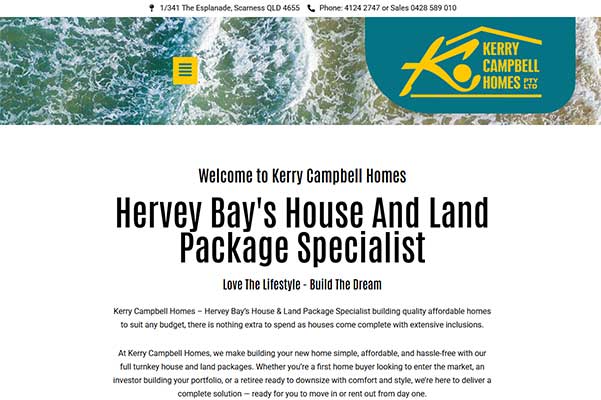
Thank you to Tina and the team at Kerry Campbell for working with us for your website rebuild. You can view the new website here:
Kerry Campbell Homes Hervey Bay
For this project we have integrated an automated property feed for house designs as well as availalbe properties for sale allowing self administration.
For property developers, a website is far more than a digital brochure. It is a central sales tool, a branding platform, and often the first meaningful interaction a prospective buyer or investor has with a project. In a competitive market where multiple developments may target the same audience, professional web design plays a decisive role in shaping perception, building trust, and driving enquiries.
A well-designed website communicates credibility instantly. Buyers assessing off-the-plan developments or investment opportunities are making decisions involving significant financial commitments. If a website appears outdated, confusing, or poorly structured, it introduces doubt. On the other hand, a clean, modern, and intuitive design signals professionalism, attention to detail, and confidence in the product being offered.
Understanding the Target Audience
Effective web design for property developers begins with a clear understanding of the target audience. Different developments appeal to different buyer segments, and the website must reflect that.
Luxury developments require a refined, minimalist aesthetic with high-end imagery, subtle animations, and a focus on lifestyle. Investor-focused projects benefit from clear data presentation, yield projections, and location insights. First-home buyers often need more guidance, including simplified explanations, affordability considerations, and accessible calls to action.
Design decisions—from typography and colour palettes to layout and content hierarchy—should align with the expectations and motivations of the intended audience. A mismatch between design and audience can weaken engagement and reduce conversion rates.
Visual Storytelling and First Impressions
Property development is inherently visual. Buyers are not just purchasing a structure; they are buying into a lifestyle, a location, and a future vision. Professional web design leverages visual storytelling to bring that vision to life.
High-resolution renders, photography, and video content should be prominently featured and carefully curated. Hero sections on landing pages should immediately capture attention and convey the essence of the development. Consistency in visual style across all pages reinforces branding and ensures a cohesive user experience.
However, visual elements must be balanced with performance. Large, unoptimised media can slow down load times, which negatively impacts user engagement and search rankings. Professional design ensures that visual quality is maintained without sacrificing speed.
User Experience and Navigation
User experience (UX) is a critical component of effective web design. A visually impressive site will still fail if users cannot easily find the information they need.
Navigation should be intuitive and streamlined. Key sections—such as project overview, floor plans, pricing, location, and contact—must be easily accessible. Clear menus, logical page structures, and prominent calls to action guide users through the site and encourage engagement.
Mobile responsiveness is essential. A significant portion of property searches now occur on mobile devices, and a site that does not perform well on smaller screens risks losing potential buyers. Responsive design ensures that layouts, images, and functionality adapt seamlessly across all devices.
Conversion-Focused Design
Ultimately, a property developer’s website must generate enquiries. Professional web design incorporates conversion-focused strategies to maximise this outcome.
Calls to action should be strategically placed and clearly worded. Whether prompting users to register interest, download a brochure, or book a consultation, these elements must stand out without being intrusive. Forms should be simple and quick to complete, reducing friction and increasing submission rates.
Trust signals also play a role in conversion. Testimonials, project timelines, developer credentials, and progress updates help reassure potential buyers. Integrating these elements into the design builds confidence and supports decision-making.
Integration of Key Features
Modern property development websites often include a range of interactive and functional features that enhance user engagement.
Interactive floor plans allow users to explore layouts in detail. Availability tools provide real-time updates on which units are still for sale. Map integrations highlight nearby amenities, transport links, and lifestyle benefits.
These features must be seamlessly integrated into the design. Poorly implemented tools can disrupt the user experience, while well-executed features add value and encourage deeper interaction with the site.
Search Visibility and Performance
Professional web design is closely linked to search engine visibility. A well-structured site improves indexing, enhances user engagement metrics, and supports broader digital marketing efforts.
Clean code, fast loading speeds, and logical content hierarchy all contribute to better search performance. While design focuses on aesthetics and usability, it must also support underlying technical requirements.
Content should be structured with clear headings and relevant information that aligns with what potential buyers are searching for. This ensures that the site not only attracts visitors but also provides the information needed to convert them into leads.
Branding and Consistency
For property developers managing multiple projects, consistent branding across websites is essential. Each development may have its own identity, but it should still align with the overarching developer brand.
Professional web design ensures that branding elements—such as logos, colour schemes, typography, and messaging—are applied consistently. This reinforces brand recognition and builds long-term trust with the audience.
Consistency also extends to tone and messaging. Whether the focus is on luxury, affordability, or lifestyle, the website should communicate a clear and unified narrative.
Scalability and Future-Proofing
Property developments evolve over time. From initial launch and marketing phases through to completion and sales closeout, the website must adapt to changing needs.
Professional web design considers scalability from the outset. Content management systems allow for easy updates, whether adding new images, updating availability, or publishing progress reports. The design should accommodate these changes without requiring a complete rebuild.
Future-proofing also involves staying aligned with evolving design standards and user expectations. A site that feels modern today should remain relevant and functional in the years ahead.
The Value of Professional Execution
While it may be tempting to treat web design as a secondary consideration, the impact on project success is significant. A professionally designed website enhances credibility, improves user experience, and drives measurable results.
For property developers, this translates into stronger brand positioning, increased enquiry volumes, and ultimately higher sales performance. In a market where buyers have numerous options, the quality of a website can be the factor that differentiates one development from another.
Investing in professional web design is not simply about aesthetics. It is a strategic decision that supports marketing, sales, and long-term brand growth.